


2026 Election Media Policy Guide
Media is in the news every day, whether it's AI, social media, misinformation, fake news, propaganda, media bias or dirty politics. But there's precious little policies from the politicians on how they would fix the problems they complain about.
So where do New Zealand's political parties stand on media?
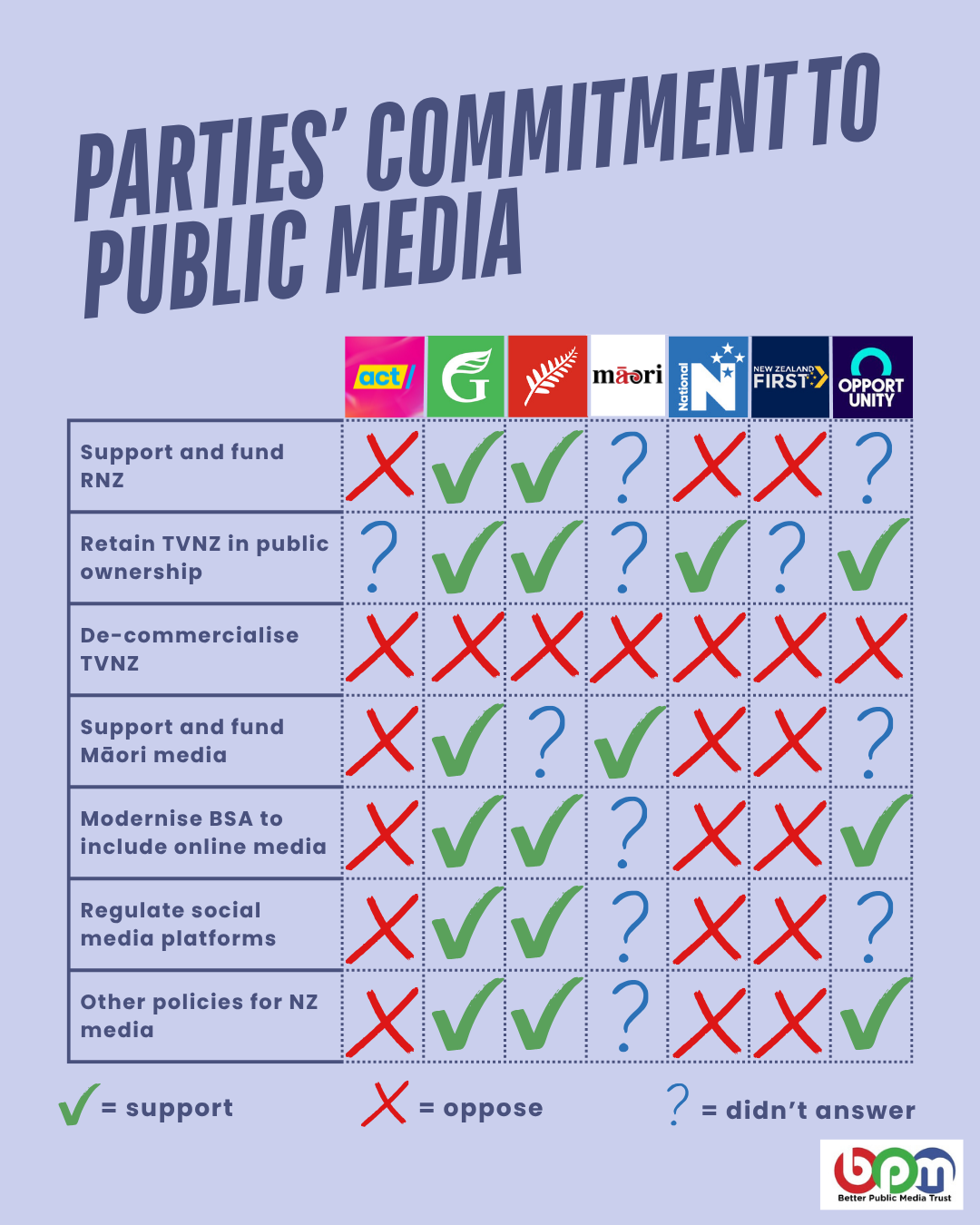
Here's a quick reference guide to help you work out which party you agree with and read the detail below for more illumination.
Public media funding
At the debate, the Green Party made the clearest commitment to increased public media funding, including Māori and community media. The Greens would restore funding for Whakaata Māori and RNZ, and increase support for Pasifika, student, community and regional media.
Labour weren't far behind with continued support for RNZ, plus plans to make screen-production incentives easier to use and “simplify public funding” which may mean merging NZ On Air with the Film Commission and even Creative NZ.
National says they will continue to fund RNZ, although they have cut RNZ’s funding in the past two budgets and froze it for nine years under the previous National government.
ACT, NZ First and Opportunity have made no general funding commitment while Te Pāti Māori has previously supported enduring and equitable Māori-media funding.
BPM says: BPM supports increased funding for public media. In particular we support public funding coming from a levy so that it is separate from government budgets.
Social media
Just before the election, National introduced a bill to ban under-16s from ‘high risk’ social media platforms. It will require platforms like Instagram, TikTok, Snapchat and Facebook to take reasonable steps to check users are over the age of 16 by using a number of methods including; using existing account information, facial age estimation, digital ID services and formal ID. Platforms used by children will have to regularly report on how risks are being identified and reduced. Emerging technology such as AI to be included. It would establish a regulator that would investigate and enforce penalties of up to 10 percent of platform income.
NZ First and ACT oppose a ban saying it wouldn’t work but don’t propose a different solution.
The Greens also oppose a ban because social media can provide benefits for young people. They would instead tackle platforms producing content that is harmful for all age groups, such as the European Union’s Digital Services Act.
Labour also offer a ban for under-16s similar to the National bill in that it would have a regulator and stiff penalties for media companies. It goes a bit further by introducing basic legal responsibilities, what they call a Digital Duty of Care, on companies that run online services, with stronger protections for under-18s. Labour will also require social media platforms to give users the option to only receive posts from people they know, thereby avoiding harmful algorithms.
BPM says: National and Labour are joined by the Greens in wanting to create a social media regulator with power to penalise platforms that don’t protect users from the harms of social media. We support this but don’t necessarily agree with an outright social media ban for under-16s. BPM favours a robust duty-of-care model including safety-by-design features appropriate for all ages.
Broadcasting Standards Authority
The BSA receives complaints about broadcast media and adjudicates on whether the broadcaster has breached its various standards including fairness, balance, accuracy and protections against discrimination, denigration, criminal incitement and harm to under-14s.
National will scrap the BSA in favour of industry self-regulation with something like the Media Council becoming the primary regulator of journalism. Media spokesperson Paul Goldsmith has argued that self-regulation could provide appropriate oversight while maintaining ethical standards and public trust. ACT and NZ First support abolishing the BSA.
Labour, Greens and Opportunity would instead modernise the BSA and broaden its protections to include online media.
BPM says: The BSA is certainly out of date (and the BSA agrees!) but National’s policy to replace it with a voluntary scheme carries significant risks. Core standards such as accuracy, balance, fairness, privacy, children’s rights and law & order would no longer be enforceable. We see more merit in Labour and the Greens proposal to modernise the BSA model and retain control of content standards across all platforms which have significant audience reach and influence.
Artificial Intelligence
Labour proposes to combat the harms of AI by updating copyright law so New Zealand creators can control over whether their work is used to train AI and develop paid licensing arrangements for commercial AI use.
The Greens would require that AI-generated media content be clearly labelled, that AI developers obtain explicit consent before training models on journalists’ work and that journalists and other creators be paid when their work is used by AI. Opportunity and Te Pāti Māori have similar policies.
National proposes continuing with what it calls its “light touch” approach. ACT also refers to a “light touch”. That would seem to be more focussed on removing barriers to AI rather than providing safeguards.
BPM says: AI is a rapidly-evolving technology with impacts on many sectors of society, including media. New Zealand needs judicious AI regulation to protect our data sovereignty and the intellectual property rights of content creators. Just because the AI tech sector is led by powerful US corporations and billionaires does not mean NZ should place their commercial interests above the democratic, cultural and economic interests of New Zealanders.
Other media policies
The other big policy announcement at this election is that Labour would reintroduce the Fair Digital News Bargaining Bill which would require large global technology platforms to compensate New Zealand news organisations for their journalism. This type of law has delivered some benefits in Australia but the primary beneficiaries are the larger commercial news media, and the big tech platforms have indicated they are reluctant to continue with future bargaining negotiations.
However in Canada it had a negative effect when Facebook chose to stop carrying news content instead, with the result that traffic to Canadian news dropped. Nevertheless news bargaining rules are supported by most of the larger NZ news media, not surprisingly considering that all newsrooms continue to lay-off journalists.
Labour also promises stronger protections against non-consensual sexual images in media such as deepfakes, and powers to take down harmful 'nudify' apps and sites. ACT have already introduced a Deepfake Digital Harm and Exploitation Bill which passed its first reading in Parliament with cross-party support.
Labour would also strengthen training and career pathways in the screen and media industries, and improve the prominence and discoverability of New Zealand content on digital platforms.
All the parties at the election debate – National, Labour, Greens and Opportunity – agreed they would not sell TVNZ. However ACT would sell TVNZ.
There was also agreement to continue funding Local Democracy Reporting and Open Justice programmes.
BPM says: These policies all have our support.
Lack of policies from ACT, Te Pāti Māori, Opportunity and NZ First
As outlined in the specific issues above, the ACT Party’s stance on media, online safety, and social media focuses on parental responsibility, free expression, and opposition to broad government bans or new regulatory bodies. ACT candidate Paul Henry has been touted as the next Minister of Media after a long career in television but has said himself that he doesn't even think a Minister for Broadcasting should exist.
ACT and Te Pāti Māori did not engage with our invitations to speak at the election debate.
NZ First did engage. Under the long-serving NZ First media spokesperson Jenny Marcroft, NZ First media policy was generally sensible agreeing with merging RNZ and TVNZ, introducing a media ‘ombudsman’ to replace the BSA, and funding for journalism from tech companies.
We invited Marcroft to speak at our election debate but she did not respond. A few days before the debate, Michael Laws called to say he would attend on behalf of NZ First. Laws, who is a presenter on The Platform and former MP, has been placed higher on the NZ First list than Marcroft and has expressed a desire to be Minister of Broadcasting. Laws then pulled out of the election debate citing delays to NZ First media policy. At the time of writing, it has still not been released. Laws has previously said RNZ would be first on his “chopping list” and regularly complains about left-wing bias at RNZ and TVNZ.
BPM says: If Henry or Laws were to become Minister of Media, it seems likely they would seek to de-fund or dismantle public media under the erroneous assumption that publicly-funded media are left-wing. BPM’s view is that publicly-funded media are essential because they fulfil significant cultural and democratic functions that commercial media cannot, including representing a full range of audience perspectives and bringing society together rather than dividing it.
2026 Election Media Policy Guide